Send the same tube of blood to the same lab twice and the best-known epigenetic clocks will hand back two different ages. On one clock the gap reaches 8.6 years. No intervention ever tested has moved a clock that far.
Why This Matters
An epigenetic clock is a laboratory score that reads chemical marks on your DNA and returns a number in years. On 21 August 2026, four days before this was written, Nature Medicine put the whole class of them under scrutiny in two papers at once, and the second was written by the man who built the first clock.
The first paper introduced TranslAGE, a database of 51 longitudinal intervention studies with 16 epigenetic clocks run across all of them. It asks a question the field had mostly assumed the answer to: do these clocks actually respond when you intervene (14)? The second was a commentary by Steve Horvath, the UCLA geneticist and biostatistician whose 2013 paper started the field, under a title that says the quiet part out loud: "Putting epigenetic aging clocks on trial" (15).
That is the state of the instrument in 2026. It is on trial, and the people running the trial are the people who built it.
Meanwhile you can buy one. A methylation test that returns your biological age costs between $249 and $599 depending on the brand. LSD has cited clock outputs in its own pages: our piece on menopause turns on them, our omega-3 piece reports a trial whose primary readout was a clock, and the rapamycin PEARL analysis leans on one. We have used the instrument repeatedly without ever explaining it. This article is that explanation.
The short version: the clocks are real research tools that measure something genuine at the level of populations. As a number handed to one person, the leading ones are noisier than almost anything they have been used to detect.
How To Read The Numbers In This Article
Four terms carry the whole argument. Two minutes here makes the rest readable.
A biological age is a score, not an age. Every clock in this article is a laboratory score built to track calendar age or mortality, a stand-in for aging rather than aging itself. When a test tells you that you are 42 and your passport says 48, nothing about your cells has been measured against a standard for what a 42-year-old's cells look like. A statistical model was fitted to a training population, your methylation was fed into it, and it returned a number in the units the model was built to output.
A confidence interval is the range of values compatible with this data. For a difference between two groups, zero is the no-difference point. If the interval includes zero, the data are compatible with there being no difference at all. Watch how close several of the intervals below sit to it.
A p-value is the chance of seeing a gap at least this large if there were genuinely no difference between the groups. It is not the chance the result is wrong.
A hazard ratio is a ratio of how fast events piled up in two groups, not a count of people. A hazard ratio of 1.5 means that at any point in the study, one group was having events about 1.5 times as often as the other. On its own it says nothing about how many people that is.
One more, on reliability. An intraclass correlation, written ICC, asks how much of the variation in a measurement is real difference between people rather than noise in the machine. At 1.0 the measurement is perfectly repeatable. At 0 it is telling you nothing about the person.
An Epigenetic Clock, In Plain Terms
DNA methylation is a chemical tag. At a site where a cytosine sits next to a guanine along the strand, called a CpG site, a methyl group can be attached or absent. Commercial arrays read hundreds of thousands of these at once: the widely used 450K array covers over 480,000 sites (18), and its successor covers more than 850,000 (19).
Each probe returns a number between 0 and 1, the proportion of DNA molecules methylated at that site (20).
An epigenetic clock is then built the way any regression model is built. Take a matrix of those numbers, pick a target, and fit a penalized regression that shrinks most of the coefficients to zero and keeps a small weighted subset. Horvath's 2013 paper states the parameters plainly: elastic net with alpha of 0.5, lambda chosen by cross-validation (1). Out of 21,369 candidate sites it kept 353.
That is the whole mechanism. There is no biological clock inside the cell that anybody found. There is a weighted sum, and the weights come from whatever the model was asked to predict.
Epigenetic alteration is genuinely one of the hallmarks of aging, and methylation patterns genuinely change with age. Both of those facts are secure. Neither of them tells you that a regression fitted on top of them produces a reliable number for one person, which is a separate question and the one this article is about.
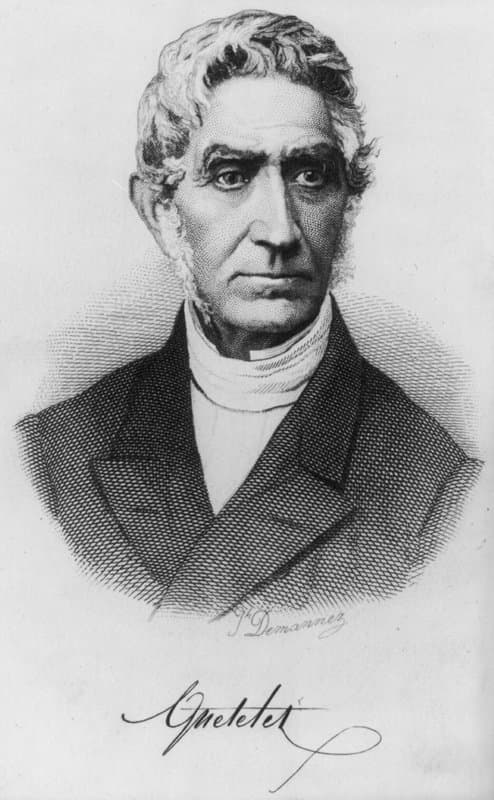
This is why Quetelet belongs at the top of this article. In the 1830s he invented the practice of taking a measurement from one person, comparing it against the average of a population, and reporting the distance between them as if the distance were a property of the person.
That is a genuinely useful thing to do. It is also the origin of body mass index, and everything people have learned about BMI's limits since applies here in the same shape: a score calibrated on a population tells you where you sit on a curve, and it can do that reliably while telling you very little about the mechanism you actually care about.
Four Clocks, Four Different Targets
The single most common misreading of these tests is treating "biological age" as one quantity that different clocks estimate with different accuracy. They are not estimating the same quantity. Each was trained on a different target, and the target is what the number means.
| Clock | Sites | Trained to predict | Reported fit |
|---|---|---|---|
| Horvath 2013 (1) | 353 CpGs | Chronological age, across 51 tissues | Correlation 0.96, error 3.6 years |
| Hannum 2013 (2) | 71 CpGs | Chronological age, blood only | Correlation 96%, error 3.9 years |
| PhenoAge 2018 (3) | 513 CpGs | A mortality-calibrated composite of nine clinical biomarkers plus age | Correlation with age r = 0.71 across tissues |
| GrimAge 2019 (4) | 1,030 CpGs | Time to death | Correlation with age r = 0.82 |
| DunedinPACE 2022 (5) | 173 CpGs | The rate of change in 19 biomarkers over 20 years | In-sample r = 0.78 with the 20-year Pace of Aging |
Read down that table and the differences matter more than the similarities.
The first-generation clocks were trained on chronological age, which means they carry a hard ceiling. A model fitted to predict how old you are cannot, by construction, be better at predicting how old you are than your birth certificate. Everything interesting about them lives in the residual, the part they get wrong.
PhenoAge changed the target. Morgan Levine, then in human genetics at UCLA and later at Yale, first built a "Phenotypic Age" from nine clinical measures, including albumin, creatinine, glucose, C-reactive protein and red cell distribution width, weighted by how they predicted mortality in a national survey, then trained methylation to predict that composite (3). So PhenoAge is methylation predicting a blood-panel score predicting death.
If that sounds like a long chain, it is, and every link in it is a place where the relationship can weaken.
GrimAge went further and trained directly on time-to-death, via methylation surrogates for seven plasma proteins and for smoking pack-years (4). It is not an age predictor and should not be described as one. Its correlation with chronological age, 0.82, is lower than the first-generation clocks precisely because it is doing something else.
DunedinPACE is the odd one out, and the most interesting. Built by Daniel Belsky, an epidemiologist at Columbia University's Butler Aging Center, with Terrie Moffitt and Avshalom Caspi at Duke, it asks how fast someone has been changing rather than how old they look.
It was trained in the Dunedin cohort, where every participant is the same chronological age, on the rate of change in 19 biomarkers measured at four time points across two decades (5). Its output is not years. It centres on 1.0, meaning one year of biological change per calendar year. Its correlation with chronological age is only 0.32.
One more piece of vocabulary, because it is used loosely everywhere. Age acceleration is not the difference between your clock age and your real age, at least not in the modern definition. It is the residual after regressing clock age on chronological age within a sample (4). That has a consequence worth sitting with: your age acceleration depends on which group you were analysed alongside. Change the reference sample and your number changes, without anything changing in you.
The Number That Rarely Appears In The Marketing
Here is the finding that reorganises everything above.
In 2022, a group led by Albert Higgins-Chen, a psychiatrist and computational biologist at Yale School of Medicine, with Morgan Levine as senior author, took 36 pairs of technical replicates, the same blood DNA run twice, and asked what the clocks said each time. Their abstract puts it bluntly: "technical noise produces deviations up to 9 years between replicates for six prominent epigenetic clocks, limiting their utility" (6).
The results text is more precise, and worse. The Horvath multi-tissue clock showed a median deviation of 1.8 years between replicates and a maximum of 4.8. Across the other clocks, median deviations ran from 0.9 to 2.4 years and maxima from 4.5 to 8.6 years. PhenoAge was the worst: median 2.4 years, maximum 8.6 (6).
Now the comparison that makes those numbers mean something. The same paper reports that the standard deviation of epigenetic age acceleration, the spread across actual different people, is 3 to 5 years (6).
So for four of the six clocks, the maximum disagreement between two runs of one sample exceeds one standard deviation of the entire biological signal. The authors say so directly: it "would be misleading for a conventional CpG-based epigenetic clock to indicate that a person has aged 9 years if the difference is solely attributable to technical variation" (6).
GrimAge is the exception, at an ICC of 0.989, which the authors attribute to its two-stage construction (6). DunedinPACE also holds up well, at an ICC of 0.96, and for a specific reason: its builders pre-filtered the candidate sites to those with acceptable test-retest reliability before fitting anything (5).
Why is the raw material this noisy? Because the individual measurements are. A 2020 study measured 350 blood samples twice each, across 438,593 sites present on both array generations, and found probe reliabilities "skewed toward zero, with a mean of 0.21 (median = 0.09)" (7). The median individual methylation probe has an intraclass correlation of 0.09 between two readings of the same DNA. A clock is a weighted sum of a few hundred of those.
There is a fix, and it works. Higgins-Chen's team retrained the clocks on principal components rather than individual sites, and the reconstructed versions reach ICCs above 0.99, with median deviations of 0.3 to 0.8 years (6). The fix is real. It is also, as we will come to, licensed.
Now Put The Signal Next To The Noise
Hold 4.5 to 8.6 years in mind, and look at what interventions have actually achieved.
CALERIE is the strongest evidence available, because it is a secondary analysis of a genuine randomised trial. 220 adults were randomised to 25 percent caloric restriction or to eat freely for two years; 197 had usable methylation data (8). Worth noting before the results: the achieved restriction averaged 11.9 percent, not the prescribed 25.
The second-generation clocks did not move. For PhenoAge, the 12-month effect was d = -0.03 with a 95 percent confidence interval of -0.19 to 0.12, and at 24 months d = 0.05, interval -0.11 to 0.20, with p above 0.50 at both points. Both intervals comfortably include zero, the no-difference point. GrimAge behaved the same way (8).
DunedinPACE did move. At 12 months d = -0.29, interval -0.45 to -0.13; at 24 months d = -0.25, interval -0.41 to -0.09, with p below 0.003 at both (8). Those intervals exclude zero, so this is a real signal rather than a shrug.
The authors then translate it, and this is the number to keep. The effect corresponds to "a reduction in the pace of aging of 2-3%." And they add, without being asked: "effect-size estimates imply close to 90% overlap of DunedinPACE trajectories between the two groups" (8). Two years of sustained caloric restriction, and nine out of ten people in the restricted group had a trajectory you could also find in the group that ate whatever they wanted.
DO-HEALTH ran the same kind of analysis on a three-year factorial trial of vitamin D, omega-3 and a home exercise programme, in 777 older adults with methylation at both ends (9). Daily omega-3 shifted three of four clocks: PhenoAge d = -0.16, GrimAge2 d = -0.32, DunedinPACE d = -0.17. Vitamin D and the exercise programme were not associated with changes in any clock, which is worth pausing on, because structured exercise has some of the strongest outcome evidence in all of longevity research. If a clock cannot see the intervention with the best mortality data behind it, that is a fact about the clock. The authors convert their own effects into a human unit: the treatment effects "ranging from 0.16 to 0.32 units (2.9-3.8 months)" (9).
Three years of daily omega-3 bought between 2.9 and 3.8 months on a scale whose instrument disagrees with itself by up to 8.6 years.
Two caveats in DO-HEALTH's favour and against it. In its favour, the design was randomised and the follow-up was three years. Against it, the paper reports no p-values at all and applies no correction for testing four clocks, and the PhenoAge interval, -0.02 to -0.30, only just excludes zero.
TRIIM is the study most often cited as proof that biological age can be turned back, and it is the weakest thing in this article. Nine men were analysed. There was no control group, no placebo, no randomisation and no blinding, and participants were "recruited for the study by word of mouth." The reported change of about 2.5 years is against a modelled expectation of normal ageing, not against a control arm. The paper states its own limit: "Reported P values do not correct for multiple comparisons" (10). A larger follow-up was announced years ago and, as of this writing, no peer-reviewed results paper for it could be found.
Set that 2.5 years beside a maximum technical deviation of 4.5 to 8.6 years on the very clocks used to measure it, in nine people, with nothing to compare them against.
The Head-To-Head Nobody Quotes
If clocks are worth what they cost, they should beat cheaper measures at the thing they are sold for. There is one study of the right shape, and its result is not the one you would expect from the marketing.
A Swedish twin cohort followed 845 people for a median of 15.8 to 19.2 years, with 3,973 repeated measurements, and put nine different biological ages head to head against death (11). Four methylation clocks, telomere length, a physiological age, cognitive function, a functional index built from grip strength, gait speed, vision, hearing and lung function, and a frailty index built from a 42-item self-reported health questionnaire.
Each measure was scaled so that one unit is one standard deviation. In the individually adjusted models, GrimAge came first, with a hazard ratio of 1.39 and an interval of 1.11 to 1.75. The frailty questionnaire came second at 1.32, interval 1.18 to 1.48. The functional index was third at 1.27. PhenoAge was 1.26, Horvath 1.17, and the Hannum clock at 1.17 had an interval of 0.98 to 1.40, which includes the no-difference point of 1.0 and so is not statistically significant.
Telomere length came last, at 1.01, with an interval of 0.92 to 1.11. That is worth a sentence of its own. Telomere shortening is the aging mechanism the public knows best, the one Elizabeth Blackburn shared a Nobel Prize for describing, and it was the only one of the nine measures here that carried no detectable mortality signal at all (11).
A mechanism can be real and important in biology while the thing you can measure about it in a blood tube is close to useless as a personal readout. That is the same trap this whole article is about.
Then they entered all nine into one model together, on the 288 people with complete data. In absolute terms, 151 of those 288 died during follow-up; the paper reports hazard ratios rather than per-group death rates, so the absolute risk in each group is not recoverable from it.
In that joint model the ordering flips. The 42-item questionnaire came first, at 1.58 with an interval of 1.32 to 1.89. GrimAge was 1.43. Horvath was 1.31. PhenoAge fell to 1.13 with an interval of 0.91 to 1.40 and lost statistical significance. The Hannum clock fell to 1.03. The functional index lost significance too (11).
The authors call the surviving measures "complementary," which is fair and is their word. What the numbers will not support is the claim the industry rests on. A questionnaire a person can fill in at a kitchen table, for nothing, out-predicted every epigenetic clock in the room.
The functional index is worth a second look too, because its ingredients are things this publication has written about individually: grip strength, gait speed, and lung function of the kind cardiorespiratory fitness testing measures directly. Those are not exotic. They are what a good geriatrician has been checking for decades.
None of this makes the clocks useless. A meta-analysis of 13 cohorts and 13,089 people found every clock's age acceleration predicted mortality at very high statistical confidence (12). But that establishes that the signal exists at large sample sizes. It does not establish that the number is informative for one person, and it does not compare the clocks against grip strength or a health questionnaire.
Who Owns The Instrument
This is where the story becomes an LSD story.
The patents on the Horvath clocks are owned by the Regents of the University of California, with Horvath and Levine as named inventors, disclosed plainly in the original papers (1, 3, 4). Horvath's most recent disclosure, in that 21 August commentary, is the fullest he has published: he is "a founder and paid consultant of the nonprofit Epigenetic Clock Development Foundation, which licenses these patents," and he "was a principal investigator at Altos Labs until March 2026 and holds equity in Altos Labs" (15).
DunedinPACE is licensed too. Its inventors' own disclosure on a 2025 paper names the licensee: it is "a Duke University and University of Otago invention licensed to TruDiagnostic for commercial uses; however, the DunedinPACE algorithm is open access for research purposes" (16).
And then there is the reliability fix. Recall that the principal-component clocks solve the 9-year replicate problem. Their paper's competing-interests statement records that those metrics "are licensed by Elysium Health through Yale University," that Elysium "provided paired blood and saliva replicate datasets reported in this study," and that the senior author "previously acted as a Scientific Advisor for, and received consulting fees from, Elysium Health" (6).
Now read Elysium's own marketing page for its consumer test. It states, in its own words, that "a single sample processed repeatedly can result in epigenetic age estimates that vary up to nine years," and that its product "shows agreement across replicates within zero to 1.5 years." The evidence it cites for both halves is the same 2022 paper (17).
Every link in that chain is documented and none of it is hidden. The company is telling you the truth about the reliability problem. It is also the company that licenses the solution, supplied the data used to demonstrate the problem, and paid the researcher who published it. That is not fraud. It is a closed loop, and a reader deciding whether to spend $299 deserves to see its shape.
This pattern will be familiar to anyone who has followed the supplement evidence base or watched the NAD+ market grow around a mechanism that is real and a benefit that is not yet demonstrated in people. The difference here is that the product being sold is the measuring instrument itself, which makes the conflict harder to see and more consequential when it bites.
What This Means For You
If you already have a result, three things follow.
First, ask which clock produced it. A GrimAge number and a first-generation Horvath number are not two estimates of one thing. If the report will not tell you, that itself is information.
Second, do not act on a single reading. On the clocks with a median replicate deviation near 2 years and a maximum near 8, a change of a few years between two tests is well within what the machine produces from nothing. If you retest, the honest interpretation of a small movement is that nothing has been learned.
Third, notice what the same money buys elsewhere. The single best mortality predictor in the head-to-head was a 42-item self-reported health questionnaire (11). The functional index that nearly matched the clocks was grip strength, gait speed, vision, hearing and lung function (11). Those are things a clinician can measure in twenty minutes.
Standard biomarkers sit in the same category: cheap, repeatable, and already validated against outcomes people care about. So do the behaviours underneath them, from sleep to what you eat, none of which needs a $299 readout to justify itself.
There is also a framing point worth keeping. A clock is a proposed shortcut: a way to find out in two years whether something worked, instead of waiting thirty. That is a genuinely valuable thing to want, and it is why serious researchers keep building these.
The question the field is now asking out loud is whether the shortcut arrives at the same destination, and the difference between living longer and living well longer is exactly the kind of distinction a single composite number tends to flatten.
And on the regulatory question, the answer is cleaner than most people assume. A 28-author consensus paper in Cell states it directly: "no aging biomarkers of any category have been approved by U.S. regulators for clinical applications" (13). The same paper notes gait speed and grip strength are not on the FDA's list of surrogate endpoints either, so this is not a slight against methylation specifically.
As Cummings and Kritchevsky put it, for a score to be a valid surrogate the treatment, the score and the health outcome must sit on the same causal pathway, and "it is a very long jump from these findings to validation that biological age is a surrogate marker" (21).
The transferable habit here is smaller than the topic. When any test returns a number, ask what it was trained to predict, and ask what it says when you run it twice. Those two questions are answerable for epigenetic clocks because researchers did the work and published it. Most of what is sold as a measurement is rarely asked either one.
Frequently Asked Questions
Is my biological age test result wrong?
Probably not wrong, but noisier than it looks. Depending on the clock, two runs of the same DNA sample differ by a median of 0.9 to 2.4 years and can differ by as much as 8.6 (6). Your result is a draw from that distribution, not a fixed property. GrimAge and DunedinPACE are the most repeatable of the well-known ones, and the principal-component versions of the others are better still.
Does anything actually move an epigenetic clock?
Yes, by small amounts. Two years of caloric restriction reduced DunedinPACE by 2 to 3 percent, with about 90 percent overlap between the treated and control trajectories (8). Three years of daily omega-3 produced effects the authors convert to 2.9 to 3.8 months across three clocks, while vitamin D and a home exercise programme were not associated with changes in any of them (9). Those are real results and they are small next to the instrument's own noise.
Can epigenetic age be reversed?
The honest answer is that the question is usually asked about the score rather than about the person, and those are different things. A score can be pushed down without anything underneath it changing, which is why regulators have not accepted any of these as a valid endpoint (13).
The most-cited claim of reversal comes from TRIIM, which analysed nine men with no control group, no placebo and no randomisation, and compared them against a modelled expectation rather than an untreated arm (10).
In the randomised evidence, the movements are small: 2 to 3 percent on DunedinPACE after two years of caloric restriction (8), and effects the DO-HEALTH authors themselves convert to 2.9 to 3.8 months after three years of omega-3 (9). Nothing in that literature supports the idea that a person's aging has been undone.
Why do different clocks give me different ages?
Because they were trained on different targets. Horvath's clock predicts chronological age, PhenoAge predicts a nine-biomarker mortality composite, GrimAge predicts time to death, and DunedinPACE predicts the rate of change in 19 biomarkers over 20 years (1, 3, 4, 5). They are different instruments with different units that happen to be reported in the same word.
Is an epigenetic clock better than a blood panel?
Not on the one published comparison. Over 20 years of follow-up, a 42-item self-reported health questionnaire predicted mortality better than every clock in a joint model, at a hazard ratio of 1.58 per standard deviation against GrimAge's 1.43, while PhenoAge and the Hannum clock lost statistical significance (11). The authors describe the clocks and the questionnaire as complementary, which is a weaker and more accurate claim than superiority.
Has any regulator approved these tests?
No. A 28-author consensus paper states that no aging biomarker of any category has been approved by US regulators for clinical applications (13). Consumer tests are generally sold as wellness products rather than diagnostics, and a lab being certified to run an assay reliably is a separate question from whether the number the assay produces means what the marketing says.
Sources
- Horvath S. DNA methylation age of human tissues and cell types. Genome Biology. 2013;14(10):R115. PMID: 24138928. DOI: 10.1186/gb-2013-14-10-r115
- Hannum G, Guinney J, Zhao L, et al. Genome-wide methylation profiles reveal quantitative views of human aging rates. Molecular Cell. 2013;49(2):359-367. PMID: 23177740. DOI: 10.1016/j.molcel.2012.10.016
- Levine ME, Lu AT, Quach A, et al. An epigenetic biomarker of aging for lifespan and healthspan. Aging (Albany NY). 2018;10(4):573-591. PMID: 29676998. DOI: 10.18632/aging.101414
- Lu AT, Quach A, Wilson JG, et al. DNA methylation GrimAge strongly predicts lifespan and healthspan. Aging (Albany NY). 2019;11(2):303-327. PMID: 30669119. DOI: 10.18632/aging.101684
- Belsky DW, Caspi A, Corcoran DL, et al. DunedinPACE, a DNA methylation biomarker of the pace of aging. eLife. 2022;11:e73420. PMID: 35029144. DOI: 10.7554/eLife.73420
- Higgins-Chen AT, Thrush KL, Wang Y, et al. A computational solution for bolstering reliability of epigenetic clocks: Implications for clinical trials and longitudinal tracking. Nature Aging. 2022;2(7):644-661. PMID: 36277076. DOI: 10.1038/s43587-022-00248-2
- Sugden K, Hannon EJ, Arseneault L, et al. Patterns of Reliability: Assessing the Reproducibility and Integrity of DNA Methylation Measurement. Patterns (N Y). 2020;1(2):100014. PMID: 32885222. DOI: 10.1016/j.patter.2020.100014
- Waziry R, Ryan CP, Corcoran DL, et al. Effect of long-term caloric restriction on DNA methylation measures of biological aging in healthy adults from the CALERIE trial. Nature Aging. 2023;3(3):248-257. PMID: 37118425. DOI: 10.1038/s43587-022-00357-y
- Bischoff-Ferrari HA, Gängler S, Wieczorek M, et al. Individual and additive effects of vitamin D, omega-3 and exercise on DNA methylation clocks of biological aging in older adults from the DO-HEALTH trial. Nature Aging. 2025;5(3):376-385. PMID: 39900648. DOI: 10.1038/s43587-024-00793-y
- Fahy GM, Brooke RT, Watson JP, et al. Reversal of epigenetic aging and immunosenescent trends in humans. Aging Cell. 2019;18(6):e13028. PMID: 31496122. DOI: 10.1111/acel.13028
- Li X, Ploner A, Wang Y, et al. Longitudinal trajectories, correlations and mortality associations of nine biological ages across 20-years follow-up. eLife. 2020;9:e51507. PMID: 32041686. DOI: 10.7554/eLife.51507
- Chen BH, Marioni RE, Colicino E, et al. DNA methylation-based measures of biological age: meta-analysis predicting time to death. Aging (Albany NY). 2016;8(9):1844-1865. PMID: 27690265. DOI: 10.18632/aging.101020
- Moqri M, Herzog C, Poganik JR, et al. Biomarkers of aging for the identification and evaluation of longevity interventions. Cell. 2023;186(18):3758-3775. PMID: 37657418. DOI: 10.1016/j.cell.2023.08.003
- Sehgal R, Borrus D, Armstrong JF, et al. Responsiveness of epigenetic aging biomarkers to longevity interventions in humans. Nature Medicine. Published online 21 August 2026. PMID: 42629466. DOI: 10.1038/s41591-026-04562-9
- Horvath S. Putting epigenetic aging clocks on trial. Nature Medicine. Published online 21 August 2026. PMID: 42629467. DOI: 10.1038/s41591-026-04524-1
- Whitman ET, Elliott ML, Knodt AR, et al. DunedinPACNI estimates the longitudinal Pace of Aging from a single brain image to track health and disease. Nature Aging. 2025;5(8):1619-1636. PMID: 40595015. DOI: 10.1038/s43587-025-00897-z
- Elysium Health. The science behind Index. Company product page, accessed 25 August 2026. elysiumhealth.com/pages/science-behind-index
- Bibikova M, Barnes B, Tsan C, et al. High density DNA methylation array with single CpG site resolution. Genomics. 2011;98(4):288-295. PMID: 21839163. DOI: 10.1016/j.ygeno.2011.07.007
- Moran S, Arribas C, Esteller M. Validation of a DNA methylation microarray for 850,000 CpG sites of the human genome enriched in enhancer sequences. Epigenomics. 2016;8(3):389-399. PMID: 26673039. DOI: 10.2217/epi.15.114
- Du P, Zhang X, Huang CC, et al. Comparison of Beta-value and M-value methods for quantifying methylation levels by microarray analysis. BMC Bioinformatics. 2010;11:587. PMID: 21118553. DOI: 10.1186/1471-2105-11-587
- Cummings SR, Kritchevsky SB. Endpoints for geroscience clinical trials: health outcomes, biomarkers, and biologic age. GeroScience. 2022;44(6):2925-2931. PMID: 36260264. DOI: 10.1007/s11357-022-00671-8
Funding Transparency
LSD is editorially independent. We receive no funding from pharmaceutical, supplement, or longevity companies, and we sell no tests. Every disclosure below is quoted or summarised from the cited paper's own competing-interests statement, not inferred.
- Sources 1, 3 and 4 (the Horvath, PhenoAge and GrimAge clocks): each paper discloses that the Regents of the University of California is the sole owner of a patent application on the invention, with Steve Horvath a named inventor on all three and Morgan Levine a named inventor on PhenoAge.
- Source 15 (Horvath's 2026 commentary): discloses that he is a named inventor on the GrimAge and PhenoAge patents, that he is "a founder and paid consultant of the nonprofit Epigenetic Clock Development Foundation, which licenses these patents," and that he "was a principal investigator at Altos Labs until March 2026 and holds equity in Altos Labs." This is the fullest disclosure he has published and it appeared alongside the paper putting the clocks on trial.
- Source 6 (the reliability paper, and the fix): discloses that the improved metrics "are licensed by Elysium Health through Yale University," that Elysium supplied the paired replicate datasets used in the study, that the senior author previously acted as a scientific advisor to Elysium and received consulting fees, and that a co-author was previously an Elysium employee. The paper states Elysium otherwise did not fund the study or shape it.
- Source 17 (Elysium's own marketing page): the company markets its test against the nine-year reliability problem while citing, as its evidence, the paper in source 6. It is disclosing a real problem and selling the licensed solution to it.
- Source 16 (DunedinPACNI): discloses that three authors are "listed as inventors of DunedinPACE, a Duke University and University of Otago invention licensed to TruDiagnostic for commercial uses," while noting the algorithm remains open access for research. TruDiagnostic sells a consumer test that reports DunedinPACE.
- Source 5 (the DunedinPACE paper itself): six of its twenty authors declare they are listed as inventors on a Duke and Otago invention licensed to a commercial entity. That paper does not name the entity; source 16, by overlapping authors, does.
- Source 14 (the TranslAGE database): discloses that two authors are co-inventors of the SystemsAge clock, that both have received consulting fees from TruDiagnostic, and that three further authors "are employees of TruDiagnostic and developed OMICmAge." The study assessing which clocks respond to interventions therefore includes employees of a company selling clock-based tests.
- Source 9 (DO-HEALTH): discloses that Steve Horvath is a founder of the nonprofit that licenses several epigenetic clock patents, including GrimAge, from UC Regents, and that he works for Altos Labs.
- Source 10 (TRIIM): discloses that four authors, including Horvath, are shareholders in or hold options on Intervene Immune, Inc., and that two are officers of the company and named in a related patent application. The clock supplying the trial's endpoint was built by one of the shareholders.
- Source 12 (the mortality meta-analysis): discloses the same UC Regents patent application with Horvath as a named inventor.
- Sources 7, 11, 2, 18, 19, 20 and 21: no industry funding or competing interests were declared. Source 7's authors declare none, which is worth noting because the same research group declared a patent and licensing interest on DunedinPACE two years later.
- Source 13 (the Cell consensus paper): several authors declare patents on measuring aging, and two are shareholders of a diagnostics company holding a patent on a methylation clock for breast cancer risk.
Related Reading
- Menopause Moves Bone and Lipids. No Clock Study Exists., an article whose central claim is a clock output, and which now has an instrument page behind it
- Omega-3s and Biological Aging, on the DO-HEALTH trial whose primary readout was four of the clocks described here
- Your Body's Biomarkers, on the cheaper, better-validated measurements that outperformed the clocks in the head-to-head
- Healthspan vs Lifespan, on why choosing what to measure decides what you find
- Rapamycin's First Longevity Trial Missed Its Primary Endpoint, on the related habit of reading a trial's headline instead of its registration
A score is only as good as the question it was fitted to, and only as useful as its answer is repeatable. Ask both before you believe a number about yourself.
Written with the help of AI tools, shaped and verified by humans. Every citation in this article was resolved against PubMed and Crossref, and every competing-interests statement was read in the publisher's own record rather than in a summary of it.
This article is for information only and is not medical advice. Talk to your doctor before acting on any test result.